Few pharmacovigilance teams set out to build a complicated safety stack. It grows one sound decision at a time.
A safety database to capture cases and drive signal detection. A Regulatory Information Management System (RIMS) for submissions and health authority commitments. A Document Management System (DMS) for controlled documents. Affiliate tools for local teams. Partner portals for licensing partners and service providers.
Then there’s everything else. Home-grown databases and in-house applications built years ago to fill a specific gap. And the manual systems that hold a surprising amount of PV work together: email, SharePoint sites and shared drives, and spreadsheets.
Each one was added for a good reason, and most do their job well. But together they form an ecosystem, and no one ever chose a way to govern it.
The trouble shows up between systems
Every system in the stack is authoritative for its own data. The safety database knows the cases. RIMS knows the submissions. The DMS knows which document version is approved. A home-grown tracker, a SharePoint list, or a spreadsheet holds whatever someone last entered.
What none of them knows is whether the work that runs across them got done.
Think about how a single obligation actually moves:
- A health authority commitment is logged in RIMS.
- It requires a safety analysis drawn from the safety database.
- The output becomes a controlled document in the DMS.
- Affiliates then have to implement a local change, recorded in their own tools.
- A licensing partner has to confirm the same change in its markets.
- Along the way, status lives in a spreadsheet, approvals happen over email, and supporting files land in a SharePoint folder.
That’s one commitment, at least five systems plus the manual tools around them, and several teams, each working to its own timelines. Every handoff is a seam, and seams are where commitments slip:
- Ownership blurs. Each team owns its step, but no one is clearly accountable for the outcome.
- Status goes stale. The only end-to-end view is a spreadsheet someone updates when they remember to.
- Evidence scatters. Proof that each step happened lives in whichever system, inbox, or shared folder it was produced in.
- Local follow-through disappears. Global teams can see what they issued, but not whether every affiliate and partner implemented it.
None of this is a failure of the individual systems. It’s a gap no single system was built to cover.
The systems no one counts
When teams map their PV ecosystem, they usually list the commercial platforms. The home-grown and manual systems get left off the diagram, even though they often carry the oversight itself.
- Home-grown systems were built for one team’s needs. They often depend on a few people who know how they work, they may not be validated, and they rarely connect cleanly to anything else.
- Email is where many decisions actually get made. But a decision in an inbox isn’t recorded against the commitment it affects, and it leaves with the person who owns the inbox.
- SharePoint and shared drives hold evidence, but folders don’t show which obligation a file supports, whether it’s the final version, or whether the step it proves was done on time.
- Spreadsheets become the de facto oversight record. They multiply into versions, depend on manual updates, and lack a reliable audit trail.
These tools aren’t the problem in themselves. The risk is that the most important question in PV, whether every obligation got done, ends up answered by the least controlled systems in the ecosystem.
Regulators look at the ecosystem, not the tools
Regulators such as the European Medicines Agency (EMA) and the U.S. Food and Drug Administration (FDA) don’t inspect your safety database or your RIMS in isolation. They inspect your pharmacovigilance system as a whole, and they increasingly expect you to show oversight, not just describe it.
That means evidence that commitments were met, that risk minimization measures were implemented in every market, and that affiliates, partners, and service providers did what they agreed to do.
When an inspector asks “are you on track, everywhere?”, the answer spans every system you run, including the home-grown and manual ones. If the only thing tying them together is a hand-built tracker, that tracker is what you’ll be putting in front of them.
What happens when you migrate or replace a system
The ecosystem doesn’t stand still. PV organizations are migrating safety databases, consolidating RIMS platforms, retiring home-grown tools, outsourcing more activities, and adding AI-assisted processes.
Each change is a governance risk, not just an IT project:
- Open commitments have to be found and carried over. Some only exist as fields, reports, or workarounds in the old system.
- Historical evidence has to stay traceable. An inspector may ask about a decision made before the migration.
- Owners and due dates get reset. New workflows mean new handoffs, and new places for things to fall through.
- The tracker gets rebuilt. Oversight logic built around the old system has to be redone around the new one.
- Home-grown tools age out. When an in-house application loses its developer or its platform support, whatever oversight it held has to be moved somewhere, often into yet another spreadsheet.
When governance lives inside a specific system, or in spreadsheets shaped around it, every system change forces you to rebuild your oversight too. That’s backwards. Your governance should be the stable part.
What a governance layer looks like
The answer isn’t to replace the systems that work. It’s to add a layer above them that governs the commitments, activities, and deadlines running across them.
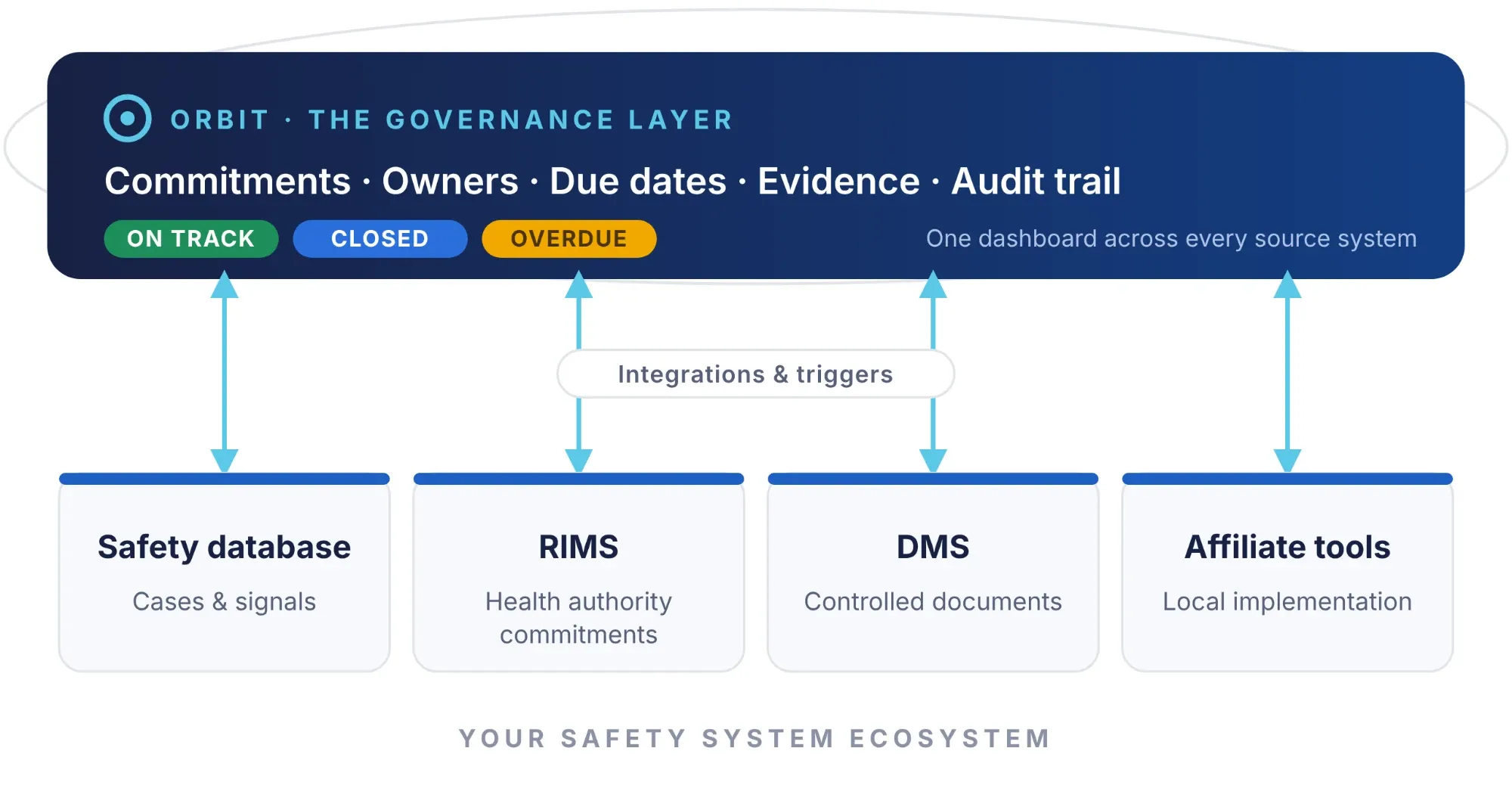
A PV governance layer should:
- Integrate with the systems you already run. Events in the safety database, RIMS, DMS, affiliate tools, or in-house applications should open tracked work automatically, without changing how those systems operate.
- Bring manual work into the record. Commitments that start in an email or live in a spreadsheet today become tracked items too, and the evidence now scattered across SharePoint and shared drives is captured against the task it supports.
- Turn every obligation into a tracked item. Each one gets an accountable owner, a due date calculated from your business rules, and a defined set of tasks to close it out.
- Show every commitment in one view. Leadership sees what’s on track, what’s at risk, and what’s overdue, whichever system it came from.
- Follow the work to every market and partner. A global commitment is distributed to each affiliate or partner as its own tracked local version, so local follow-through stays visible.
- Keep the evidence with the work. Proof is attached at the task level, with a complete audit trail that survives staff turnover and system changes.
- Run on a validated platform. An oversight record is only as credible as the platform it sits on.
With that layer in place, each system stays authoritative for its own data, and the governance layer is authoritative for the oversight. You can add or replace a source system without redesigning how compliance is overseen, because the oversight never lived in that system to begin with.
Where Orbit fits
Orbit is a validated SaaS platform built to be the governance layer for pharmacovigilance, risk management, and patient safety. It integrates with your safety database, RIMS, DMS, affiliate tools, and in-house systems, and works alongside your entire safety system ecosystem rather than replacing it. What it does replace is the oversight that today lives in spreadsheets, email threads, and shared folders.
Orbit’s Activity Templates define the work each type of obligation requires. Paired with integration triggers, they let a new RIMS commitment, a safety database escalation, or a document going live in your DMS open the right tracked item in Orbit automatically. From that point on, the commitment is governed in Orbit, from first trigger to final evidence, on the same dashboard as everything else.
Orbit’s global-to-local oversight has also been independently evaluated. In a peer-reviewed study at a global biopharmaceutical company, 95 percent of respondents reported improved global-to-local communication after adopting Orbit for risk management oversight (Ingate et al., Therapeutic Innovation & Regulatory Science, 2025).
The bottom line
Your safety stack was built one good decision at a time, from enterprise platforms to home-grown tools to the spreadsheets that fill the gaps. Governing it shouldn’t depend on a spreadsheet, an inbox, and a few people who remember where everything lives.
Govern the ecosystem, and every system in it gets easier to oversee, change, and defend.
You’re passionate about patient safety, not spreadsheets.
Download the white paper: The Pharmacovigilance Governance Layer →
